

#4 Where Have All the Poets Gone?
On Regaining the Spirit of the Poet in a New World

Introduction
Hello everyone! I am sorry that it has been so long. Life, as always, is busier than I expected. Since I have not been able to finish any recent essays, I thought I would take the time to go back and edit a paper I wrote for my English comp class back in high school. My teacher originally gave me a 90%, but I hope it is 100% for you all.
I do not necessarily agree with everything I wrote back then, and I can’t help but sense some reductionism seeing as I have gained more knowledge and wisdom since the penning of this piece, however, I am still proud of it and I also think that reading it might allow more of you an insight into my journey as a writer. The biggest take away will probably be that I use less big words now than I used to. You are welcome.
Before we get started, I would like to dedicate this piece to two poets who give me hope.
and have been ministering to my soul through their exceptional compositions. I highly recommend checking out their work!So without further ado, I present a 16 year-old Jonathan’s Magnum Opus
“If more of us valued food and cheer and song above hoarded gold, it would be a merrier world.”
-J.R.R. Tolkien
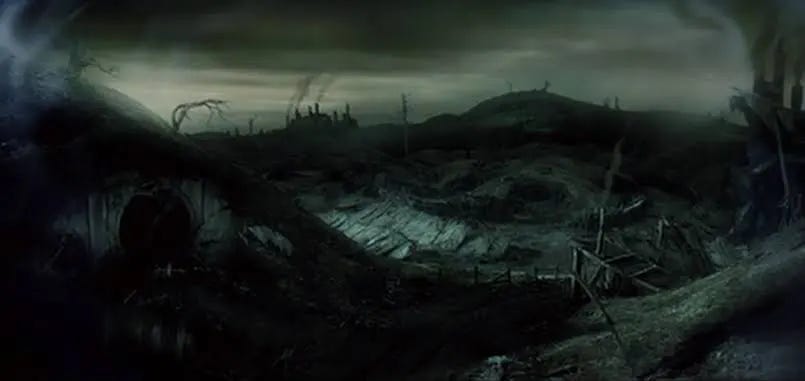
-The Scouring of the Shire
Essay: The Death of Poetry
Poetry, we all love to hate it. Every passing winter and infant spring, the English department decides to bolster the poor grades of the fatigued youth with a unit on the musings of countless venerable crusty white guys. With works ranging from high minded saccharin verse, to unmelodious post modern prose, these poems succeed in providing students with five or six assignments that they can easily breeze through before moving into the subsequent units It seems to be this shallow reprieve is all that the teens glean from the ancient art. It is this alarming relationship between the current generation and poetry that begs a question: is this the death of poetry?
Statistics show that in the five year gap between 2017 and 2023, poetry readership in the U.S. declined “nearly 3 percentage points” (Iyengar). The question on the survey was merely whether or not the participants had read poetry in the past year. Any survey measuring avid enjoyment or consistent reading time would surely be lower than the current 9% figure. So, is poetry resigned to linger in the halls of dreary schools and stuffed up esoteric institutions until it fades past the point of resuscitation? Sadly, the answer is probably yes. But before a time of death is declared, it is imperative that we know what killed poetry. I intend to argue that the death of poetry is the direct result of a severed connection between mankind and the natural world, and a severed connection between man and his fellow man. These disconnects have been spurred on by the ecological impacts of the industrial revolutions and the advent of secular thought in the West. In order to understand how these events are responsible for the death of poetry, we must discover what poetry actually is and who makes it.
What is Poetry? Who are Poets?
Poetry, simply put, is a form of literary art written with specific rhythmic patterns intended to express the thoughts and feelings of the author. The subjects of poetry and the patterns they are packaged in can vary depending on the historical and geographical context of the author. While poetry is practiced all throughout the world, this paper limits its scope to Western poetry. Poetry as a form also puts specific emphasis on the meaning of words, using various techniques to invoke a variety of tones. Poetry is distinguished from normal writing (or prose) by the line- a way of formatting poetry that limits the amount of words per line which creates a unique stanza shape. The origin of poetry, like many things in the West, comes from greco-Roman and Judeo-Christian influence. The poets Homer and his Roman counterpart Virgil were the pioneers of epic poetry. The Hebrew Torah and the Bible also include extensive poetic sections in the Psalms and other books. From there, the practice migrated to western Europe, and then eventually to America some millenia later.
While these ancient poems were songs before they were textual artifacts, their preservation through text would come to define the history of poetry following the primeval era. Poetry memorization and recital are still core tenets of the art of the culture, but we shall examine it as a textual art nonetheless.
-edit from 2025
Because poetry is defined as an outpouring and expression of the author, the characteristics of poets themselves are important to understand when striving to comprehend poetry holistically. The foremost characteristic of a poet that separates him/her from other authors is a widened sensitivity to the world around them, as well as a keen self awareness. This philosophy of the poet was articulated in the preface to Lyrical Ballads by William Wordsworth. Of poets, he says; “He is a man speaking to men: a man, it is true, endowed with more lively sensibility, more enthusiasm and tenderness, who has a greater knowledge of human nature, and a more comprehensive soul,” (Wordsworth 6). This idea that a poet is in tune with his environment has its parallels to other art forms. It is in the way that a painter is extended through the brush, or the violinist harmonizes with the viola, that the poet writes. To embody the aesthetic qualities of truth and beauty, the poet must be certain in his delivery, never faltering. Still, even if he falters, he must extrapolate from his perilous footing a mournful confusion and contempt for the shroud set upon his vision so as to maintain internal rhythm. It is why so many of these poetic types are prone to fall into melancholic spells; they are not afraid to wallow in it.
However, Wordsworth wrote these words over two centuries ago. A modern interpretation of the poetic process focuses on the idea of experiencing nature. What was once thought to be a necessity in life is now a luxury enjoyed by those whose particular passions have drawn them to ancient practicums. Wordsworth lived in a time where the only requisite action to observe nature was pause. Now any budding poet must traverse miles of cement to be alone in wild nature. It seems awfully inconvenient to go all that way just to be able to write a couple rhyming lines. Is nature really all that crucial for poetry to exist?
What is Nature?
The modern guide to writing poetry provided by poet Holly Lyn Walrath has a section where she describes open areas and green spaces in urban communities as “the new nature”. It is here where Walrath, who undoubtedly harbors benign intentions, severely confounds nature with environment. An environment in an ecological context refers to a habitat in the biosphere that is delineated by certain parameters of climate and location. In recent nomenclature, environment connotes the idea of the physical space around a person- the only parameter being proximity to the subject. Nature, on the other hand, is an aggregate and comprehensive term that encompasses all preexisting physical phenomena.
One proponent of this philosophy towards nature is the esteemed American poet Wendell Berry. Berry is a fifth generation farmer in Point Royal KY where he has remained for the entirety of his octogenarian life. Berry has articulated a strong argument for this perception of nature as more than the sum of its parts. His argument is thus: if we understand the anatomy of a person and the functions of each individual part, and yet “we accept an obligation to help them preserve their wholeness, which is to say their health”, then should we not do the same for nature? (Berry). A failure to recognize the value of nature is “rooted in our inability to see the parts and whole as one non-transferrable good” (Vranna). The parallel between nature and child does continue past their multifaceted singularity to also illustrate the responsibility conferred upon the parents as analogous to the way mankind is called to steward nature. This calling on mankind is perceived as contingent on our existence within nature, which provides for us the resources we need as a race to survive.
Further evidence for this perception of nature is found in another great, older, American poet. Henry David Thoreau was a Unitarian minister in Cambridge, Massachusetts before joining the transcendentalist movement in the mid 19th century and moving to Walden Pond in order to study nature. Most academic attention paid to Thoreau is aimed toward his seminal work Walden, although there is an argument to be made that his most complete work was in The Maine Woods. This collection of Thoreau’s journals display the deep care he took in cataloging the life of the Maine woods. It is clear from these entries that he drew from many sources in nature for his poetry.
Underneath the pretense of his anthropomorphized bird sketches and melodious lyricism, Thoreau was compiling the earliest known documentation of migration patterns and life cycles for the flora and fauna of Maine. These journals were instrumental in the development of ecological sciences in America. Furthermore, it was due to his familiarity with the particulars of nature that Thoreau was able to embody the whole of it in his poetry. The same is to be said of Wendell Berry, whose 89 years of farm life has certainly acquainted him with the diminutive parts of nature. It is the inner workings of nature that has enlightened them to its composite state and interdependency. A fact that stirred admiration and fear from the two great poets.
The state of nature is whole, and its history in poetic tradition does not indicate whether or not it is necessary for the further development of poetry. The necessity of nature in poetry is actually derived from the separation of mankind from the singular entity of nature. The purpose of poetry in many ways is to make sense of this conflict and mediate between man and nature. Nature is outside, something that we can harness for some purposes, but never fully control. Poetry is unique however in its attempts not to control nature, but rather to draw inspiration from and impose expression onto its canvas for all to understand.
Once again, a parallel can be drawn to music. Music theory is a methodological way of thinking that helps label and categorize various parts of music so that it can be comprehended by all. If a musician says that a song is in the key of C, other musicians in the Western tradition will immediately understand what that means and be able to play or listen along. In the same way, poetry has a taxonomy, and that taxonomy is nature. When Shakespeare writes in the voice of Romeo saying that “Juliet is the Sun”, everyone automatically understands what he means (Shakespeare, 2,2,2,). That is because we all are subject to the sun and its rays. In the same way we are all subject to thirst and shade. Poets have the unenviable task of transposing their innermost thoughts and feelings into art that has broad accessibility. Thus they rely on nature to relay the emotive information through metaphor.
The early 20th century theologian and author G.K. Chesterton outlines the other desirable aspects of nature in poetry throughout his droll commentary in the essay Cheese. There are three principles therein to expound upon.
Firstly, the antiquity of nature suits it for an art form older than known history. Secondly, nature has so many parts and variables that it is easy to find word substitutions in order to fit a rhythmic scheme. Third and finally, aspects of nature vary based upon region, allowing certain localities and communities to independently develop culture through poetry that appeals to unique regional variations. Chesterton’s use of cheese to depict regional variance could easily have been swapped for local divergences in geological phenomena and organic life.
Herein lies another important principle of nature. When viewed holistically, there is greater appreciation for the individual variations in parts. From the perspective of an ax, the trees in Oregon and Maine would be reduced to lumber. The poet's perspective reveals that because those trees are part of the same system, we can appreciate their inherent differences. Chesterton exemplifies this through the comparison he draws between locally sourced cheese and mass produced soda water. One has a distinct identity based on its environment while the other retains ubiquitous banality. Chesterton’s work harkens also to the issue of industrialization which was a familiar concept for the Englishman who lived through World War I. It is this industrialization that eventually formed the modern environment where one must reach out and extend further than ever before to experience nature.
Separation from Nature
The consequences of industrialization on Western life have been explored and recorded ad infinitum, and yet many living in the West today have not taken the time to understand the significance of industrialization. It is a process so preeminent that one essay could never sate its indomitable vacuum. For the purposes of this essay, the most important aspect of industrialization is the way it impacted poetry by poorly stewarding nature. The earliest industrialization began in England in the latter half of the 18th century. The Watt steam engine as well as innovations with coal created a new manufacturing system. Previously, most goods were acquired through subsistence agriculture complemented by a merchant class who would supply goods impossible for the average farmer to procure. The construction of factories and the advent of the steam plow meant that farmers who were now out of a job could move to the city and earn a wage by gaining proficiency in a single simple skill. The move to cramped quarters that were rented or leased often required wives and children to work in order to pay for food and housing. The population of Britain more than tripled in one century from 6 million to 21 million (Cartwright). The primary change here was from a pastoral environment to a concrete jungle. During this period, there were many poets who stood in stark opposition to this change.
In her poem, The Cry of The Children, Elizabeth Browning mourns the tragic lives of the children who are forced to work in mines and factories. Children who greet death as a long expected friend. Children whose only experience of flowery fields are the soot stained weeds creeping along the ventricles of the mines. Machines of industry fed on coal and lumber to sustain power while also pumping thick black smoke into the cities. What little part of nature that remained in cities, that being air, was corrupted with harmful particulates. Poor waste management and sanitation meant that disease was rife among the working class. Like a wolf among sheep, cancers and colds preyed upon an unsuspecting populace. Ultimately, this change from rural to urban meant a complete supplanting of nature in society.
The upheaval caused by industrialism in England, and soon after in America, carried with it a subversive threat to our relationship with nature. This danger is the prominence of mechanical aides. Although mechanical aides have created more efficient urban life styles, they have completely removed a component of our synchronicity with nature. For the vast majority of human nature, man rose with the sun and laid his head to rest with the sun. This reliance on the sun for light was a key mechanic of mankind's ability to provide. With the invention of the light bulb and the alarm clock, this connection was forfeited.
The example of mechanical aides comes from an excerpt of Henry David Thoreau's Walden. Thoreau bestows on this ideal the principle that man ought to live deliberate lives. This was the purpose of his retreat into the wilderness for two years. To confront “only the essential facts of life, and see if I could not learn what it had to teach, and not, when I came to die, discover that I had not lived.” (Thoreau, 118). This is a restatement of Socrates' famous quote that “an unexamined life is not worth living”. This philosophy on life is congruent with Wordsworth’s definition of a poet as deeply sensitive and aware of all aspects of life. Both Wordsworth and Thoreau had this obsession that a simplified life is one where the metrics of vivacity are most accurate. This is displayed in Wordsworth's observation of rural life and Thoreau’s obsession with a life stripped of distractions. It is no accident that these two formed such similar ideas seeing as Thoreau’s transcendentalist movement was the American successor of the European romantic movement that Wordsworth had triumphed over. So how do the lives of these two men compare to the experience of the average American today?
As would be the estimate of most Americans, the amount of time we spend outside is very low. In the study of Human Geography, the United States of America is categorized as a stage four demographic country. This means that we are a rich country with long life spans and advanced medical care. Furthermore, it means that we have a high percentage of populations in suburban communities and high labor participation in tertiary and quaternary sectors. This means we have a low proportion of people with jobs in manufacturing and agriculture.
The result of a population having primarily white collar jobs is lower involvement with nature. One study named The Nature of Americans National Report, found that more than 50% of Americans claim to spend less than 5 hours outside every week (“U.S. Study Shows Widening Disconnect with Nature, and Potential Solutions”). This despite the fact that many of them expressed a desire to enjoy the outdoors. Another survey from the APM Research Laboratory found that 31% of Americans cite their occupation as their primary impediment to spending time outdoors (“How often do Americans spend free time in nature?”).
Corollary to the shift in labor is also a change in American recreation. An inverse relationship has developed between outside activities and consumption of digital media. Is this sort of relationship with nature conducive to the poetic experience? In his book length essay, Poetry, Ralph Waldo Emerson describes his experiences with nature in religious terms. In his writing, nature exists as a spiritual key to understanding oneself. In this way, nature undergirds truth and beauty through inspiration and enlightenment. Under this presumption of nature, a connection with it must be prerequisite for the poet. In that case, America is systematically killing her poet class with menial clerkships and digital distractions. However, urban culture is not the only thing killing our connection with nature. Simply put, there is much to be said for how much of nature we physically consume.
The phrase, “you are what you eat” was first uttered by an early 19th century French lawyer and gastronome named Anthelme Brillat-Savarin. This axiom refers to the principle of causality that we all operate by implicitly. If anything has been learnt from Thoreau and Socrates, then an unintended action cannot be a directly meaningful one. The logic of this phrase is that the characteristics of people are dependent on what they consume. Whether that be food, art, or the friendships they partake in. In the context of nature and poetry, this axiom is important because it reveals an important repercussion of industrialization. Mass produced and globally consumed foods have removed the amount of local nature that a given person is actually participating in. If people in 18th century America were products of whatever harvest they and their neighbors had both reaped and sown, then what are we the products of today? This question is similar to the point that Chesterton made with the soda water. Our friend Wendell Berry has something to say on this issue. Berry delves into the matter during an interview with Indiana Public Radio’s Shana Ritter. It is from working on a farm for a lifetime that “you realize that living from your own place and eating food from your own place makes you one flesh, so to speak, with that place. You are made of your place.” (Ritter). This relationship here between Berry and his “place” is one of deep profundity and intimacy.
Once again it is imperative to ask, how does this stack up compared to the modern American? An article from Forbes magazine answers this question with shocking results. According to their citation of a Washington Post newspaper article, roughly 16 million people in the U.S. believe that chocolate milk comes from brown cows. Potato chips and french fries are the most popular vegetables, and the most popular fruit is orange juice (Holden). This disturbing lack of agricultural literacy is the direct result of mass production of the food we eat. Therefore, if what we eat on a regular basis is artificial enhanced foods that we know next to nothing about, we become artificial people with lowered awareness. According to Emerson’s perception of nature as integral to self, and Wordsworth’s emphasis on awareness, this process is another way we have culled poetry.
Separation from the Fellow Man
Wendell Berry’s love of place was not just the product of nature, but rather a confluence of nature and neighborly love. When writing about the deforestation of his beloved willows on the Ohio River, Berry foresees revival in nature only through neighbors and local communities coming together; “they can do this only in ways that are neighborly, convivial, and generous, but also, and in the smallest details, practical and economic.”
Berry’s invocation here is truly touching, but is it possible in modern America? Data coming from an article published by the Institute for Family Studies details this decrease in trust among neighbors. One statistic shows that “only a quarter of Americans said that they know most of their neighbors”. Another reveals that the percentage of people who say they share monthly social night’s with their neighbors has dropped from 44% in 1978 to 28% in 2018. One can only imagine how COVID impacted this statistic. We do not trust each other, we don’t even know each other. The effect of this on poetry is as equally disastrous as our untethering from nature. Indeed, it is an extension of that amensalistic relationship. For poetry to be the mediator between nature and man, the poet must have access to the deepest recesses of both groups.
Thoreau missed this point when he chose to isolate himself, but Wordsworth practiced it in his prose observations of rural man. There is an argument to be made that the digital age has removed the physical aspect of our relationships, making the new neighbors our internet peers. This may be the case for the personal lives of many, but it is not a sustainable model. Man is both a corporeal being. If you remove the physicality of a relationship, it will be unbalanced. The same is true of a purely physical relationship. The removal of physical parameters in a relationship also strips the intimacy of friendship and commiseration. It is this unbalance that is the impetus for poetry’s irrelevance in the modern day. Interpersonal and prosocial endeavors lose their flavor when they are unbound by non-physical interaction.
The misconception of our current generation that we as gregarious beings can interact solely in a non-physical space is one derived from a secular humanist world view. Theologian and historian Francis Schaeffer details the epistemological history of secularism in the west throughout his book: How Should We Then Live. The conclusion of his book is that our society has made the judgment that traditional western morality is not fit for the new generations. Schaeffer describes the result of this ontological change as twofold. People in our new society desire personal peace and affluence. Personal peace is a pervasive apathy wherein we begin to lose care for the worries of those around us so that we may maximize attention on ourselves. Affluence on the other hand is “an overwhelming and ever-increasing prosperity- a life made up of things, things, and more things” (Schaeffer, 205). When I first read this account two years ago, I deemed it to be a precise expression of current society. But in recent weeks, I have come to realize that the society we currently reside in is the pendulum swung from where it was when Schaeffer wrote in 1976.
Wordsworth had a similar account of poetry when he wrote Preface to Lyrical Ballads. In the midsection of the piece, the poet extensively critiques the prevalent superfluidity of poetry in his time. Poets would write not from the heart, but from heads warped with hot air. Their poetry was an exercise in excess, a declaration of their own excellence and proficiency with the written word. In so doing they destituted their craft and abandoned their earnestness (Wordsworth, 5).
Going back to Schaeffer, his assessment of the contemporary social norm was one fixated on material gain and uninterrupted solace. Today I look out and see the masses clambering for connection, ready to rid themselves of any possession in order to feed their lonely hearts. The preverbal Newton’s cradle has rocked and we are seeing the impact of that shifting social momentum. In a much more elongated period, the institution of poetry has reacted to Wordsworth’s criticisms and has advocated for a form so earnest and authentic, it has almost lost the traditional rhythmic parameters of poetry. This, in part, is do to the untethering of the modern man from any solid basis for goodness, truth, and beauty. The desire to express has become recursive and warped.
Daniel Böttger, A self published poet out of Germany, had something to say on this in his 2018 article: Why Modern Poetry Systematically Sucks. Böttger cites a lack of criticism, irreverence for its forebears, and lack of popular consumption as the cause for lackluster modern poetry (Böttger). While it is true modern poetry has diminished in popularity, is generally ignorant of what has come before, and does not retain popular appeal, many of these poems are beautiful in their sincerity. Böttger, like Thoreau, forgets the beauty of our fellow man. He forgets nature. It is in the remembrance of nature, here there is hope.
Conclusion
As I edited this paper, I realized that I had become darkened and nihilistic in my perception of poetry. The divorce between man and nature may be the greatest it has ever been, but that doesn't necessarily mean that poetry is dead. The diminishing aspects of poetry as observed in this essay were most definitely the result of industrialization, the globalization and mass production of food supply, and recent leaps forward in social technology.
It is also true that we have become severed from our nourishment, severed from our neighbors, and severed from ourselves. Because of that, America has grown so that commerce, infrastructure, and mass production have become necessary to keep the population alive. There is no going back to the Romantic era. In the same way the Romantics yearned to be amongst the Enlightenment. It is a condition of man to look back longingly. Therefore, our inability to return to pre-industrial society does not mean that poetry is dead.
Poetry is not just the words and rhymes that compose it. No matter how few people are still making that trek in the wilderness, no matter how few people are knocking on their neighbors door, poetry will still be alive as long as there are men and women willing to abide in it. This too is a principle of nature. There are ebbs and flows. Lush meadows and sunny days are cohabitants with rocky crags and fiery tempests. The oracles of old espoused prophecies of harvest and famine, of ascension and descension. These are not signs that we too flow with the seasons, abiding by the paroxysmal pendulum of nature’s cycle. Nature is a microcosm of life and death, in the same way that we as humans experience constant death and rebirth. Yet if we were to change with the frequency of nature, we would lose ourselves. No, instead we should strike a chord with it in all its forms. Right now, poetry seems to be dying, but soon it will be living and growing again. In both ways we ought to live like the poet. With heightened awareness and superhuman tenderness.
Practically speaking, this does mean making that trek past the concrete wasteland. It means knocking on your neighbors doors. It means taking out your earpods and experiencing nature to the fullest extent of all your faculties. It may mean planting a garden. But most of all, it means looking upon your fellow man with love and admiration. This is the spirit of the poet. It will not be easy, the distractions of our age are numerous and formidable, but we are called to live our lives deliberately. The sum of this deliberation being so that one day we may look back and know with certainty that we lived a life worth living. Furthermore, we may hope for future generations, a steady footing and a sure path in navigating the tumultuous balancing act called life. This is the convivial, the communal, and the radical restoration that can occur in the most microscopic ways. Each one of us pressing upon the heart of poetry in tiny tremors. Murmurs of resuscitation, whispers of air.
“When despair for the world grows in me
and I wake in the night at the least sound
in fear of what my life and my children’s lives may be,
I go and lie down where the wood drake
rests in his beauty on the water, and the great heron feeds.
I come into the peace of wild things
who do not tax their lives with forethought
of grief. I come into the presence of still water.
And I feel above me the day-blind stars
waiting with their light. For a time
I rest in the grace of the world, and am free.”
-Wendell Berry, The Peace of Wild Things
Epilogue
I hope that was as interesting for you as it was for me. I remember really enjoying working on this paper. I hope to one day expand on the concept and do some deeper work, where I can actually dissect some of the poems written by the people who influenced it.If you did enjoy reading this, please let me know in the comments. I’d love to read any poetry recommendations that you may have.
In all of my epilogues, I try to tie the message of the article in with my goal of being distinctly pro-life. I do not want to give a sermon here, but I was dwelling on what poetry might look like for someone who has a had an abortion and regrets it. The grief and the shame born by many women who were either coerced into murdering their child, or who simply didn’t realize the consequence of their actions, or even who knew what they were doing and must live with themselves, those weighty struggle have to be channeled some where.
Poetry works because it is an effective artistic channel in which everyone can partake. I hope that as our anti-culture is renewed and becomes a culture of life, we might go from writing The Waste Land to singing The Four Quartets. What I am trying to say is that poetry can be a redemptive force when properly channeled, because it partakes in beauty that flows from Christ.
The generations who have had abortions, the generations recovering from pornography addiction, the generations who have destroyed their bodies through perverse gender ideology, the generations who have starved and cut themselves—the people who are hurting, which is to say everyone—must send their anguish somewhere. That hurt can be redeemed when we lay it down at the cross. How much more beautiful would it be to see those burdens wrapped in poetry, offered to the Lord, and sanctified as seeds in a cemetery.
I know that all seems tangential from the body of this piece, and that’s because it is. But I just wanted to share what is on my mind. Thank you.
I ought to slap a like on here for the complimentary tag! Thank you for recommending my work to your readers.
However, I'll have to think for a while more about what you've written. As a poet, I spend more time writing poetry than theorising about it, so I'm not sure whether I agree with you about the primacy of nature in poetry. It is a very interesting theory. But the premise "poetry is dying" is one I reject; and if that premise is the conclusion of the argument, "The experience of nature is integral to poetry; people no longer experience nature; therefore people no longer write poetry," the rejection of the conclusion may or may not constitute the rejection of the argument.
I think of the metaphysical poets of the 17th century whose work is indeed marked by what you describe as "a keen self-awareness," but whose metaphors are often drawn from civilisation, not the natural world. I am simply not sure how absolute the relationship between the experience of nature and the expression of poetry is. Certainly one cannot reduce poetry's origins to nature. And there is a lot of interesting poetry arising in the current era that reflects an experience of the world mediated by what one might call hyper-civilisation, and technology.
As far as the fundamental question of the essay, "Where have all the poets gone?" I think it a misconceived one. In any age there has only been a handful of truly great poets. It is an art that demands so many layers of gifting and cultivated skill that any consistent, timeless achievement in it is necessarily rare. Yet right now and present here on Substack are some serious contestants for today's "truly great poets" – Paul Pastor, Isabel Chenot, Cameron Brooks, Mark Rico, Joffre Swait, J. Tullius, and Alex Rettie all stand a good chance of having their bodies of work persist in English poetry for decades or centuries.
It is true that our current Anglophone cultures have misplaced their poets. The poetry establishment of journals and publishing houses have elevated quite a lot of trash for quite a few decades, reflecting the degradation of visual art, music, and dance that has resulted from 20th century deconstructionism, but that doesn't mean the good stuff isn't out there. It's just not elevated in the public sphere. I think the internet is about to change all of that as it is operated in the service of those who have not lost their cultural memory or their taste for the objectively true, good, and beautiful.
Thanks for the food for thought. I will be mulling over your arguments as I take long walks through the English countryside. 😉
Francis Schaefer’s writings were a major influence in my early 20’s development of theology and philosophy. Also having spent countless hours in the wilds I can relate to how this draws us to our creator and appreciate His creation.